From Tamales to Tara: Discovering Mexico’s Unexpected Cultural Crossroads
Vibrant colors, rich aromas, and welcoming smiles greeted me as I crossed the border into Tijuana, Baja California, Mexico, challenging my preconceived notions about immigration issues influenced by living in a border town.
I worked with colleagues and students who crossed the border every day to attend classes/work in the United States and then returned to Mexico to have dinner with their families.
How Mexico Shaped Me Before I Ever Visited
It seems almost strange to me now that it took me so long to visit Mexico, despite the large influence its people, culture, and language have had in my life while growing up in Oklahoma. After all, Mexico has positively influenced my life in many ways.
Spanish: A Language That Became Mine
Language is one example. Spanish is the first foreign language that I formally learned in school. In fact, I consider Spanish to be my second language because I feel most comfortable speaking it.
Tamales in My Freezer & Tex-Mex in My Bones
Food is another area where Mexico has left its mark. I’ve always had a constant stream of Americanized Mexican food, Tex-Mex, and authentic Mexican in my diet for the last fifteen years. If you opened my freezer on any given day at my dorm during my university days, you would always find a huge pack of homemade spicy tamales that were continually provided to me by my mom’s colleague. Another food I love that’s said to have Tex-Mex origins is jalapeño cornbread with cheese.
“Mija” and Memories: The Families Who Raised Me
Beyond the language and food, Mexico has also positively influenced my life through its people. When my family first moved to Oklahoma, our neighbors were Mexican-Americans who identified being from Chihuahua. One of my earliest memories of Christmas was a sleepover at their house and excitedly opening gifts with their kids under the Christmas tree on Christmas morning. Because I played with their younger children all the time, I was continuously called “mija” (English Translation: my daughter in feminine form) a term of endearment to address girls or women in Spanish.
Mentors, Managers, & Mexican-American Connections
My mom had numerous colleagues who were Mexican, and she supervised many employees from Mexico at her previous job. Her Mexican managers took her out to lunch at authentic Mexican restaurants serving Barbacoa de Lengua Tacos (beef tongue) and invited her over to their houses on many special occasions such as for their daughter’s quinceañeras.
In elementary and middle school, my best friends were from different parts of Mexico. Later, in my graduate program at college, most of my classmates were Mexican as well from the states of Veracruz and Puebla.
I’ve never had corn on the streets of Mexico when I visited but I sure do like Mexican style street corn flavored things, Panera Bread soup, Corn Nuts flavor. One of the things I miss while I’m abroad is all the flavor options no matter what product it is. What do you mean there is only one? What about the other flavors? There are no other flavors. Oh boy, how do y’all live? 😅
Visiting Tijuana for the First Time
When I—a young, unarmed woman of color in my mid-twenties—visited Tijuana, I felt no fear. I was met with only friendly and helpful faces. Was I supposed to fear the group of locals who smiled and politely gave me directions? Or how about the hipster teenagers telling me about the best coffee shop in town?
Despite these deep cultural connections, it wasn’t until then that I truly experienced the warmth and diversity of Mexico firsthand. With an open mind and a sense of wonder, I embarked on my journey to Tijuana.
I Expected Fear. I Found Guava Cheesecake.
As one might expect, the border town of Tijuana was bustling with activity just like any other town, with people going about their daily routines as I experienced a pleasant time and came across some unexpected surprises. I stopped to grab some guava cheesecake in Zona Río, an outdoor shopping outlet, which included the Cinépolis showing the latest Hollywood films, heladerías (ice cream shops), restaurants, and stores with the latest fashion brands.
The streets buzzed with energy, filled with the lively chatter of couples holding hands, families spending time together, grandparents playing with grandkids, and parents scolding children. I encountered a lively atmosphere with musicians playing instruments to entertain tourists, and street hawkers trying to sell their wares.
Is Tijuana Really More Dangerous Than Oklahoma?
While in Tijuana, I found myself feeling skeptical of the people who told me that I was going to a gang-ridden city where there was nothing to see or do and that I should not waste my time visiting. What was all the alarm about? I experienced beautiful scenery, delicious food (spicy octopus tacos, anyone?), and a lovely atmosphere.
In comparison, I wouldn’t visit specific parts of my hometown in Oklahoma during certain times of the day due to the potential of experiencing violence, and that can be applied to many major cities in the USA. That is not to say that violence and crime doesn’t exist in Tijuana or other parts of Mexico, but one must exercise common sense and take precaution as they would while traveling anywhere in the United States and the world.
Surprises in Rosarito and Ensenada
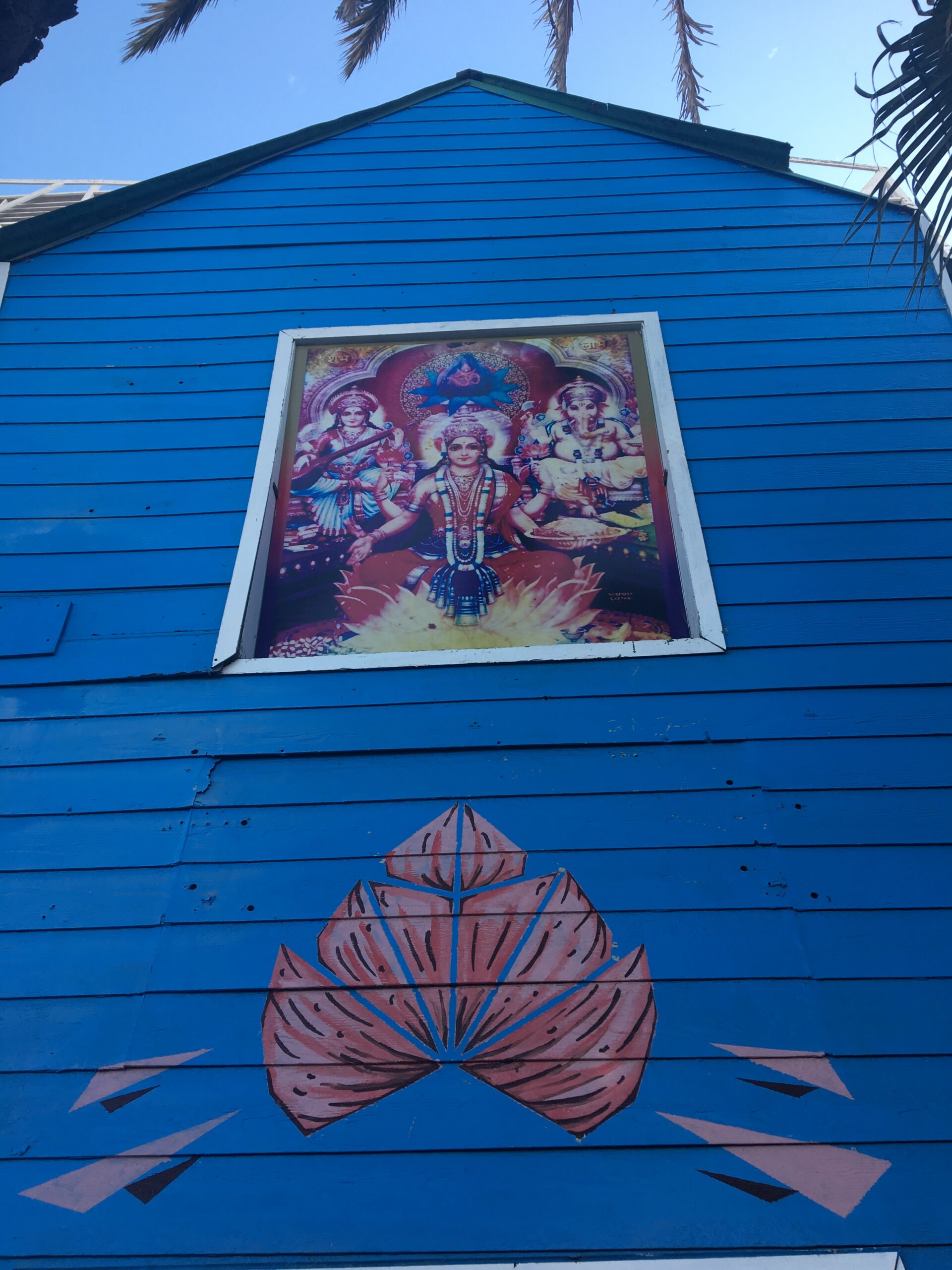
Continuing my journey while walking down the streets of nearby beach town Rosarito, an unexpected sight awaited me: three of the most famous Hindu deities, Lakshmi, Saraswati, and Ganesh, staring down at me from a building.
Ganesh, Chilaquiles, & a Puerto Rican Chef
This building happened to be a restaurant by the name of Goa Indian Fusion, which was owned by a Puerto Rican man. With the trills of Spanish being spoken and restaurants selling tacos at every corner, the last thing I expected to find was an Indian restaurant serving typical Indian dishes such as butter chicken and samosas alongside beef empanadas and chilaquiles!
The restaurant was closed for a private event that day, so I couldn’t sample their fusion cuisine, but the hostess gave me a tour of the inside, where Indian-spired décor mixed with walls plastered with photos of the owner’s time in India (one picture even showed him meeting the Dalai Lama!).
Intrigued by the cultural diversity I had witnessed, I ventured further south to the port city of Ensenada, where another surprise awaited.
White Tara on a Mexican Cliffside
Due to Mexico being a Catholic-majority country, I was somewhat shocked to find El Jardín De Tara (English Translation: the garden of Tara) overlooking the port city of Ensenada. The white Tara is a twenty-foot sculpture of a female bodhisattva in Tibetan Buddhism and the female version of Buddha in Vajrayana Buddhism who represents the compassionate aspect of Mother Nature that signifies purity, wisdom, and truth.
This monument is said to have been presented as a gift of peace and friendship by a Nepalese international cultural organization to the coastal city of Ensenada. One can enjoy sweeping views of the city and the beautiful coastline of Baja California from this vantage point, which is surrounded by colorful Tibetan prayer flags with ancient Pali script written on them.
Many Lives, One Kitchen: A Culinary Gem in Ensenada
My cultural exploration of Ensenada continued, and I was hugely surprised to see the number of Chinese restaurants in this city. As I wandered through the city, I stumbled upon a culinary gem: a Taiwanese dish called Three Cup Chicken that is rarely found on the menus of most Taiwanese and Chinese restaurants in the United States.
Learning about the restaurant owner’s fascinating journey of identifying as being from mainland China, living in South Korea, L.A., and then living in Ensenada for fifteen years made me feel alive again. A story I probably wouldn’t have heard if I hadn’t ventured out of my comfort zone. There is nothing like being in a foreign land and hearing a stranger’s life story.
From Ensenada to Havana: Following the Threads of Asian Migration in Latin America
After returning home, I started researching more about the history of Chinese immigration to Mexico and look forward to visiting the largest Chinatown in Mexico in the city of Mexicali—the capital of the state of Baja California. My fascination with learning about Chinese and Asian immigration in Mexico and Latin America led to adventures in Chinatown in Lima, Peru, and Havana, Cuba, over the next few years since this experience in Ensenada.
Why I’ll Never See Mexico the Same Way Again
My journey through the state of Baja California opened my eyes to the kaleidoscope of cultures coexisting in Mexico, affirming its richness and diversity, despite having only visited a tiny dot of this vast and magnificent country.
For anyone who still has any negative perceptions, I hope my story and pictures will challenge your perceptions. Or better yet, feel free to reach out and talk to me!
If I don’t respond right away, it’s probably because I’m busy creating more detailed itineraries of adventures down South!
¡Nos vemos en México!
(English Translation: See you in Mexico!)
© 2019 – 2026 Aanika I. All Rights Reserved.
🛤️Related Cross-Cultural Discoveries & Personal Journeys
🇮🇳 From Kollywood crushes to coastal temples
How South Indian states shaped my heart through music, cinema, and sacred landscapes.
🐉 Munay: When The Dragon Knew My Name
🇮🇩 Fandom without borders 🎶
Fifteen years as a Sahabat NOAH taught me about connection, language, and cross-cultural music devotion.
🇧🇩 When a bowl of rice becomes your lifeline 🍚
Reflections on memory, migration, and why ivory grains mean more than food ever should.
🇺🇸 Why libraries gave me the world
How public libraries became my passport to hidden histories, powerful women, and global empathy.📚